
Now Hiring a Direct Support Professional (In-Home Care) | Learn More & Apply

Starting In-Home Care Early as Preventative Care
How early support protects family relationships before the breaking point. No more waiting for burnout, the ER, or a crisis to force a decision.
Stephanie Alexander, Founder Northern Lights Living
8/17/20265 min read


Too many care decisions happen in crisis mode.
A fall. A hospitalization. A scary phone call. A caregiver who hits a wall and can’t keep pushing through. And suddenly the whole family is scrambling, making rushed decisions under pressure, trying to sort out care when everyone’s nervous system is already maxed out.
When care starts that way, it rarely feels like support. It just feels like survival.
But it doesn’t have to be that way.
I’ve worked in social services for 25 years. I’ve helped families from the professional side of the table, and I’ve lived it at home, too, after my cousin Shelley moved in to live permanently with me and my husband. And I can tell you this from both perspectives:
The best time to start care is before you’re in crisis. The second-best time is now.
Why “wait and see” feels safer (until it doesn’t)
Most families don’t delay because they don’t care. They delay because:
They don’t want to overreact.
They don’t want to take away independence.
They don’t want to upset Mom or Dad.
They’re hoping it’s “just a phase”.
They’re trying to respect privacy and dignity.
They’re scared of what it means if they admit things are changing.
So they tell themselves, “We’ll manage a little longer.”
And for a while, they do.
But what I see again and again is that “a little longer” often turns into months or years of strain, and then care begins in the worst possible way: after something everyone was afraid of finally happens.
The early signs most families miss (or explain away)
The warning signs usually show up quietly. They’re not dramatic, so it’s easy to dismiss them. But they’re real, and they add up.
Some of the most common early signs look like this:
Missed calls or strange gaps in communication. You call. No answer. You call again. Still no answer. And your body goes into that low-grade alarm.
Food changes. The fridge is technically “fine,” but it’s milk, eggs, condiments, and not much else. Or meals are getting skipped because cooking feels overwhelming.
Looping conversations. The same stories. The same questions. The same confusion that wasn’t there before.
Clutter and house changes. Not a disaster, just… different. A home that used to be tidy slowly gets harder to manage.
Bruises, “close calls,” and little falls. “I fell. It’s no big deal.” But you notice it’s happening more often.
Medication confusion. Pills run out early. Refills are missed. Directions get mixed up.
Growing isolation. People stop getting out. They stop seeing friends. Their horizons seem to shrink smaller and smaller until it’s as if the four walls of the house contain them.
None of these signs may be an emergency today. But they’re often the beginning of a pattern that leads to an emergency later.
And the hardest part is that families feel it in their bodies before they can fully name it, like rain cloud hovering over your head all of the time.”
And for adult kids especially, it can feel like living in a constant alert state. In her words, “a low grade state of alarm.”
If that’s you, you’re not imagining it. Your nervous system is responding to uncertainty.
The question that changes everything: “What are we waiting for?”
This is the moment when families often slow down.
Because “wait and see” sounds reasonable, until you ask the question behind it:
What are we waiting (and seeing) for, exactly?
What’s the event that makes it “official” enough to get help?
Most families don’t actually know. And that’s not a judgment. It’s just the truth.
They’re waiting for clarity. They’re waiting for certainty. They’re waiting for the moment where nobody can argue with it anymore.
But what that usually means is they’re waiting for a crisis.
And I’ve seen what that costs:
Emotionally
Financially
Physically
Relationally
Because once a crisis happens, you don’t get to make calm decisions. You make fast decisions.
What families wish they had known
I hear some version of this all the time from my clients:
“I wish we had started sooner.”
Not because they regret caring for a loved one. Not because they didn’t love enough.
They regret how hard it got before they reached out for support.
Earlier support often could have:
Prevented burnout
Reduced conflict and tension in the family
Kept small challenges from becoming unmanageable
Helped the person receiving care stay steadier and safer
Created more good days in the middle of a hard season
And there’s another big lesson here, one that I carry from my years in disability services and apply to every older adult I meet:
People thrive when support is built around their routines, preferences, and goals, not around what’s easiest for staff.
That’s not just a “nice idea.” It’s a care standard that my team and I uphold.
Because the goal is not to drop care into someone’s home like a disruption. The goal is to build support around the life they already have.
How preventative care changes the experience
When care starts early, everything shifts.
Instead of feeling like an emergency intervention, it becomes a partnership. It becomes a plan. It becomes something you can shape.
1) Care feels more seamless
When you start before crisis, there’s time for:
Trust-building
Learning routines
Adjusting schedules
Finding the right fit
Nobody’s panicking. Nobody’s forcing it.
2) It reduces isolation
Loneliness is a real health risk. Having consistent companionship and support can change the whole tone of a week.
Sometimes care is as simple as someone coming in to:
Make meals
Do laundry
Take a walk
Play cards
Talk through the day
And that matters more than people realize.
3) It gives caregivers their nervous systems back
This is the part families don’t plan for, but they feel it immediately. The constant scanning for danger can finally stop. Support helps the nervous system stand down.
4) It protects relationships
This is the piece I want every family to understand. Care is not only about tasks. It’s about relationships. Recently I was working through an in-home assessment with a dad and three adult children. The kids were exhausted, and they had to say they couldn’t keep doing everything. And then one of them spoke up and told his dad exactly what having support gives back:
“Dad,” he said. “Now, when your kids come over, you’re just going to have dad-and-kid time again. It won’t be all about the chores.”
That is the win. Not just showers getting done. Not just meals in the fridge. Not just meds organized.
Quality time to actually enjoy your relationship in the months and years you have left to be together.
I’ll say it one more time, because it’s the truth:
The best time to start care is before you’re in crisis. The second-best time is now.
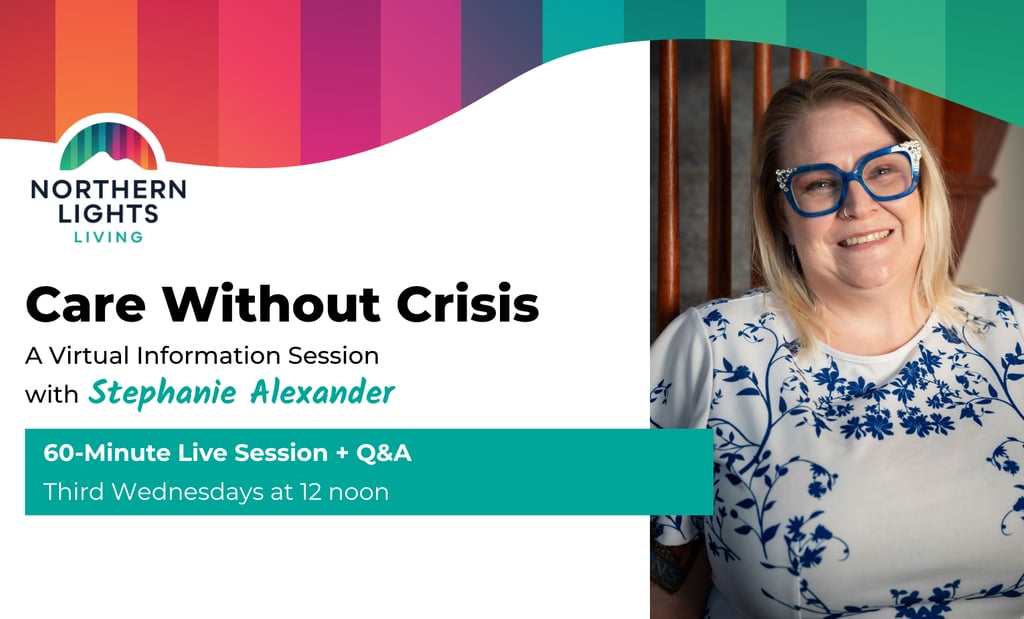
I host a free Office Hours once a month on the third Wednesday at noon.
It is a supportive, practical space to learn how to spot early warning signs, talk about help, and build a plan before a crisis forces your hand.
Northern Lights Living
Illuminating the Way to Quality Care
© 2026. All rights reserved.
Connect on social