
Now Booking Private Pay Clients - All Others Coming Soon | Office Hours Q&A on July 15 - Join Us!

Caregiving Guilt: Why It Shows Up (and What to Do With It)
In-home care isn't about replacing family. It's about protecting family relationships. We seek support so we can show up for the people we love in the way we want to.
Stephanie Alexander, Founder Northern Lights Living
7/13/20265 min read
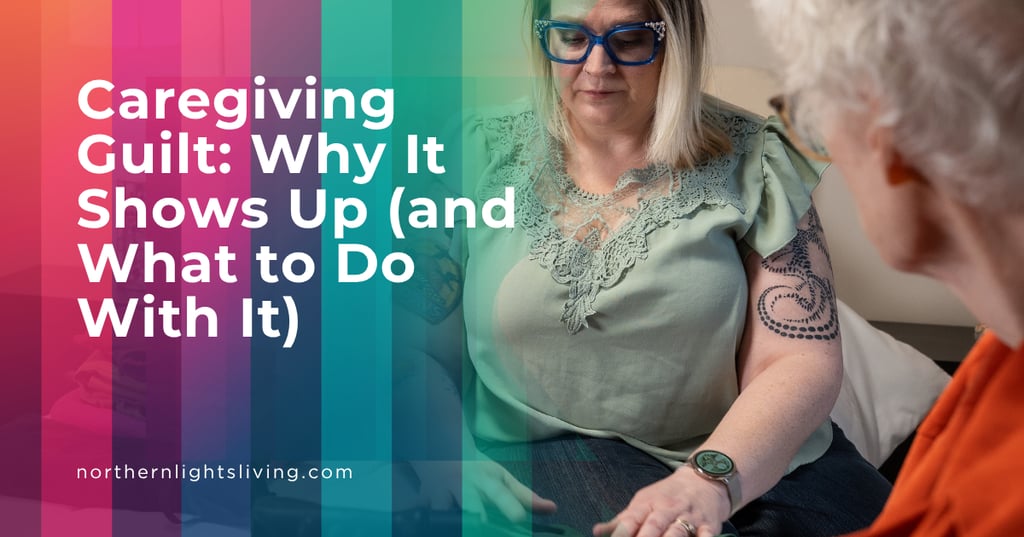
Guilt is usually one of the first emotions that shows up when families start exploring in-home care.
Not because you're doing something wrong. Because you love someone, and you're trying to hold a situation that keeps getting heavier.
A lot of adult kids feel like they should be able to manage it all. A lot of spouses feel like, "This is what I signed up for." And underneath it all sits this quiet fear: If I bring in support, does that mean I failed them? Did I fail at loving them well?
I want you to hear this, plain and simple:
Guilt shows up because you care so much. But caring doesn't mean you have to do everything alone.
Why guilt feels so convincing
Guilt has a way of sounding like truth.
It says things like:
"If I loved them enough, I'd have more patience."
"Other people do this without support."
"If we start care, we're admitting it's that bad."
"If I bring someone in, I'm handing them off."
I've spent 25 years in social services, and two years ago my cousin Shelly moved in with my husband and me. I have sat on both sides of the table. The professional side and the exhausted family side. And here's what I know from both:
Caregiving changes your nervous system. It can feel like there's a rain cloud hovering over your head all the time. You end up living in a low-grade state of alarm, where every phone call makes your stomach drop. Is this the phone call?
And if you're a spouse or partner, there's another layer. There's never an off shift because home is where the caregiving is happening.
That's not a character flaw or a failure of love. That's the reality of caregiving.
Guilt is a manifestation of love, but it's not a plan.
What I've observed is that families don't often realize that guilt is just love with nowhere to go.
You love them. You want them to be safe. You want them to be respected. You want them to stay true to themselves.
And you also might be exhausted. Stretched thin. Snappy when you don't want to be. Feeling resentment, and then feeling guilty about that. Wanting to go hide in your room and shut the door, and then feeling guilty about that too.
It's a lot to carry. It really is.
So instead of asking, "How do I get rid of guilt?" I like to ask a different question:
What is guilt trying to protect?
Usually it's trying to protect love, identity, and family loyalty. For a lot of us, there's a generational piece too. Especially for folks in their 60s, 70s, and 80s, who were raised not to say the hard thing out loud. That a very German, Scandinavian "I can do it" attitude. Asking for support was never modeled for us, so of course it feels wrong.
But guilt doesn't actually protect relationships. Support does.
Care should support the life someone wants to live.
There's a misconception that hits families right in the chest: the idea that if care starts, independence ends.
I believe the opposite. Care should support the life someone wants to live.
That protection isn't just physical safety. It's relational safety, too.
One of the biggest losses families describe to me isn't just energy or time. It's that the relationship starts to disappear under the task list. Conversations become logistics. Visits become work. Love starts to feel like obligation. Nobody wants that. But it happens.
There's also grief underneath all of this, on both sides. People grieve the life they had in their 20s, 30s, 40s, 50s. It's a real loss of who they were and who they are. When we honor that grief instead of rushing past it, care conversations get easier and feel a whole lot gentler.
I'll never forget an in-home assessment I did with a dad and his adult children. The kids were exhausted, and they had to say it out loud: "Dad, we can't do this anymore. We're tired. We need help." Hard words to say to your dad. But here's what I told him:
"Now when your kids come over, you're just going to have dad-and-kid time again."
That is what families are really trying to get back.
Accepting support isn't abandoning responsibility
You're not abandoning responsibility by accepting support. You're choosing sustainability so you can show up as your best self for the people you love.
An in-home professional caregiver doesn't replace the circle of care. They join it.
Practically, that can look like meals and routines, bathing support and personal care, laundry and home safety, rides and errands, and companionship that reduces isolation.
But emotionally, it means something bigger: you get to be a daughter again. A son again. A spouse again. Not just the manager of everything.
I learned this in my own home. When my cousin Shelly first moved in with us, my husband and I were both working full-time. She lost 25 pounds because she said she was eating, but she wasn't. Love was there the whole time. What was missing was support built into the day.
"What are we waiting and seeing for?"
If you've been stuck in the wait and see season, I want to ask you the question I ask every family:
What are we waiting and seeing for? What are we waiting to see? Do you even know?
Most families don't actually know what the "official moment" is. There isn't one. And the longer the wait and see season stretches, the more likely it is that support arrives only after a scare, a fall, a hospitalization, or burnout you can't unfeel.
I don't say that to be scary. It's just a reality I have seen over and over again.
Starting earlier creates room for adjustment without crisis pressure. Trust-building with in-home, consistent caregivers. Routines that feel seamless. Better outcomes for everyone in the circle of care.
It's not giving up. It's getting ahead of the crash.
Support gives you the relationship back
Families often come to us thinking the goal is "help with tasks."
But the deeper goal is usually less tension. More peace. Fewer fights about logistics. More actual connection.
Getting your relationship back.
In-home care matters not because love isn't enough. But because love shouldn't require you to grind yourself down to prove it.
If you're carrying guilt right now, you are not alone. And you don't need certainty to take a small step.
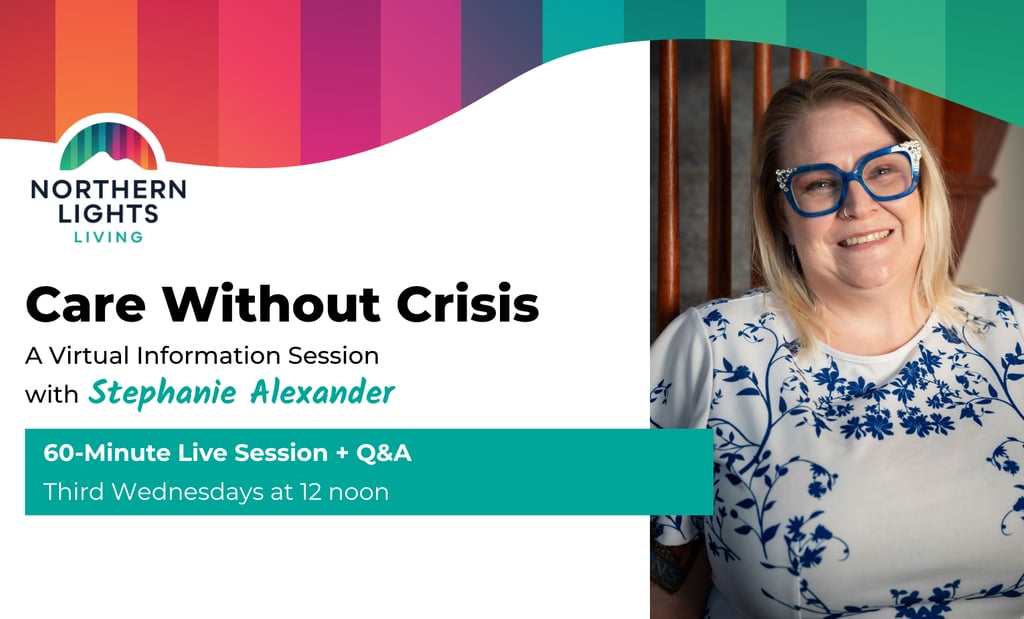
I host a free Office Hours once a month on the third Wednesday at noon.
It is a supportive, practical space to learn how to spot early warning signs, talk about help, and build a plan before a crisis forces your hand.
Northern Lights Living
Illuminating the Way to Quality Care
© 2026. All rights reserved.
Connect on social